
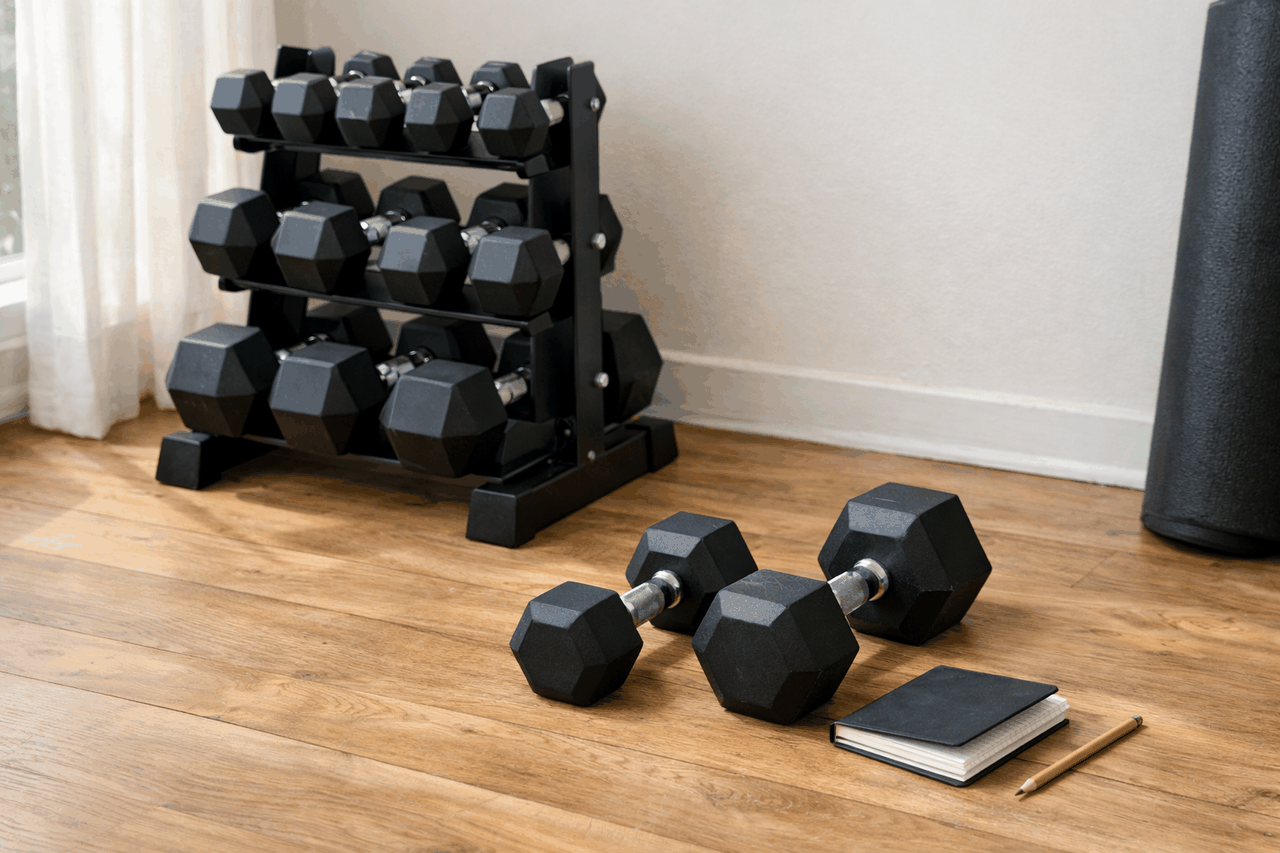
Progressive overload means increasing training demands over time as your ability improves. A repeatable workout log helps you decide when to add repetitions, increase resistance, or hold steady. The next increase should follow evidence that you can handle your current work with consistent execution and adequate recovery.
Start with one movement, a clear repetition target, and a standard you can repeat. Then let several comparable sessions guide your next step.
Choose one demand to change
Adding weight is one way to apply progressive overload. You can also increase repetitions or sets, extend range of motion, or change another feature of the exercise. Each changes what the session asks of you.
For a straightforward starting method, keep the exercise, number of sets, rest periods, and execution consistent. Work within a repetition range. Build repetitions at the same weight, then consider a small load increase after repeated clean efforts at the top of that range.
Changing one planned variable makes the result easier to interpret. If you add weight while shortening rest and adding a set, a difficult session gives you several possible explanations. With one change, you have a clearer basis for the next decision.
Make your log repeatable
Record the movement, load, working sets, and clean repetitions in each set. Add a short execution note, an effort estimate, and relevant recovery information. “30 pounds, 12/12/12, consistent depth, about two reps left” tells you much more than “squats felt good.”
Define a clean repetition before comparing sessions. For a goblet squat, that might mean reaching the same chosen depth with steady balance and a controlled descent. A repetition that becomes shallower to finish the set belongs in the notes, outside the clean-repetition count.
Keep recovery notes brief and concrete: sleep, lingering soreness, and unusual fatigue are useful context. A demanding session followed by poor recovery can produce a weaker performance. That entry helps you decide whether to repeat the current demand before increasing it.
Three sessions, three decisions
Consider a hypothetical lifter doing goblet squats with one 30-pound dumbbell. The setup stays at three working sets of 8–12 repetitions, with two minutes of rest between sets and the same execution standard. Their previous comparable entry was 12, 11, and 10 clean repetitions. All loads and observations below are fictional.
| Session | Load | Working sets | Clean reps by set | Execution and effort | Recovery | Next step |
|---|---|---|---|---|---|---|
| 1 | 30 lb | 3 | 10 / 9 / 8 | Counted reps met the standard. An additional shallow attempt on the final set was excluded. Effort was near the limit. | Five hours of sleep and lingering leg soreness. | Preserve 30 lb, three sets, and the 8–12 range. Check recovery before the next session. |
| 2 | 30 lb | 3 | 12 / 12 / 12 | Consistent depth and control. Estimated two clean reps left on the final set. | Usual sleep of about 7½ hours. Soreness had resolved. | Repeat the same setup to see whether the top-of-range performance is repeatable. |
| 3 | 30 lb | 3 | 12 / 12 / 12 | Same execution standard and approximately two clean reps left on the final set. | Usual sleep and normal readiness for training. | If available, try 32 lb next time. Keep three sets, the 8–12 range, rest, and execution unchanged. |
Session 1 earns a hold. Performance fell below the previous entry, effort rose, and recovery was poorer. Keeping the prescription steady gives the lifter another comparable exposure.
Sessions 2 and 3 support progression because the lifter repeated the top-of-range result with consistent execution and similar effort. Using two such sessions is the decision rule for this example. The fictional two-pound increase illustrates a manageable equipment option, not a universal escalation rate.
At 32 pounds, the clean repetition count may fall within the existing range. Record the actual result. If the lifter cannot reach eight clean repetitions per set under the same conditions, the log supports returning to the previous load.
When the next weight is a large jump
Suppose the available dumbbells jump from 30 to 35 pounds. That adds five pounds, about 17% of the current load. The equipment has created a much larger step than the two-pound option.
A practical alternative is to extend the repetition target deliberately. After Session 3, keep 30 pounds and three sets, then aim for 13 / 12 / 12. That raises the total from 36 to 37 clean repetitions while changing only the repetition target. Keep rest and execution the same.
If that result is repeatable with suitable recovery, a later target could be 13 / 13 / 12. Reassess the larger weight when the log supports trying it. Repetition increases can also become difficult, so use performance to set the pace rather than expecting another rep every session.
Use the log within your larger plan
A two-to-three-day full body workout plan is a useful next step when you need to organize training across the week. Use it to cover major muscle groups, then apply these progression decisions to individual movements. ACSM recommends resistance training that engages all major muscle groups at least twice weekly for healthy adults.
Hypertrophy training is the next use when muscle growth is your main priority. It requires attention to total weekly work for each muscle group. ACSM’s evidence synthesis found greater growth with higher weekly volume, including the category of at least 10 sets per muscle group per week. Treat that finding as programming context, with progression guided by the work you can perform and recover from.
Your next workout needs a clear target and a reason for choosing it. A log can justify adding demand, repeating it, or easing it. Each decision helps keep training responsive to your performance.
Sources and evidence
The session log and its decision thresholds are teaching examples. The sources below support the underlying principles and broader programming context.
- NASM: Progressive Overload Explained describes progression variables, training logs, and recovery checks.
- ACSM’s 2026 resistance training position stand synthesizes evidence on strength, muscle growth, and training prescription in healthy adults.
- ACSM’s updated guidelines summary emphasizes consistent training, major muscle group coverage, and programming for different goals.